Basura Vision
In developmentFinds the litter in a video and sorts each item into the four bins Philippine law sets out.

- Bins · RA 9003
- 4
- Materials
- 8
- Trained model per frame · GTX 1660 Ti, no API call
- 40 ms
- Jev pipeline per frame · OWLv2 + Jev
- ~2.1 s
About
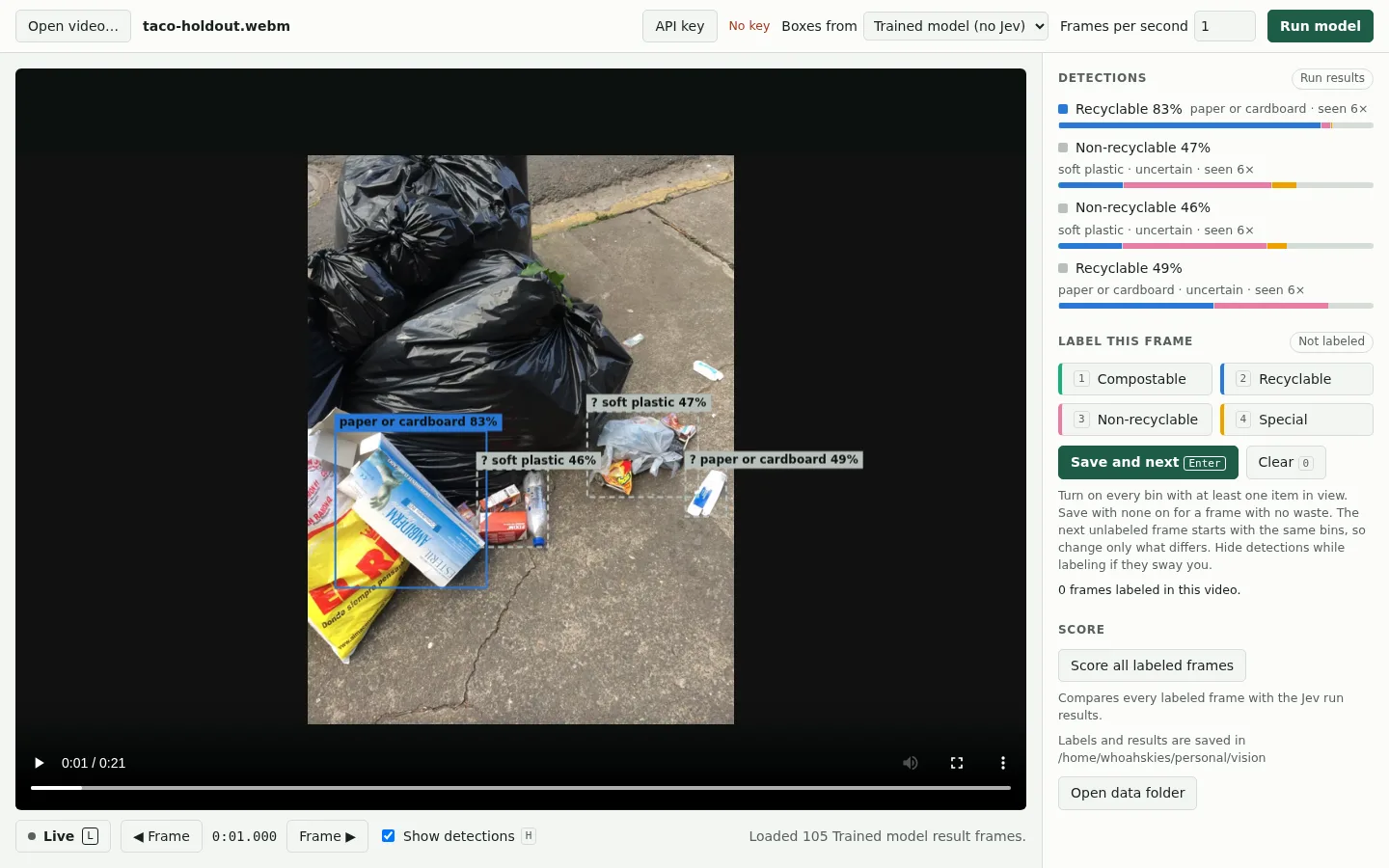
A desktop app that boxes every piece of waste in a video and classifies it into the RA 9003 bins: compostable, recyclable, non-recyclable and special. A local open-vocabulary detector proposes the boxes, TypeSafe's Jev model verifies and classifies each crop zero-shot, and a YOLO11s distilled from Jev's own answers does the same job with no API call.
- Electron
- Node.js
- TypeSafe Jev
- OWLv2
- YOLO11s
- ONNX Runtime
- Transformers.js
- DirectML
- ffmpeg
What's in it
- Zero-shot pipeline: OWLv2 proposes boxes on the GPU through DirectML, Jev checks each crop is a real object and picks one of eight materials, and items are tracked across frames so one bad frame cannot flip a call.
- Jev leans toward the first option it reads, so every crop is asked twice with the options reversed and the two answers averaged.
- A YOLO11s distilled from Jev and CC BY trash photos runs at 40 ms a frame with no key. On held-out video it agrees with Jev far less than Jev agrees with itself, and the app says so.
2 more
- Live mode classifies the frame on screen; a labelling panel builds the eval set and scores it per bin.
- The API key is encrypted with the OS key store and never reaches the page, and the page never sends file paths to the main process.
How it flows
Jev pipeline
- Video frames
- OWLv2 boxes
- Merge duplicates
- Jev verifies and classifies
- Track across frames
- 4 bins
Trained model
- Video frames
- YOLO11s distilled from Jev
- Track across frames
- 4 bins
Screens show the trained model on held-out TACO photos (Proença & Simões, 2020, CC BY 4.0), not footage of unknown rights.